
Challenge
As we are entering an age where biology and technology is merging, how might we invite people to broaden their perspective of time as an absolute and call attention to empathy regarding other life forms in which we stem from?
OUTCOME
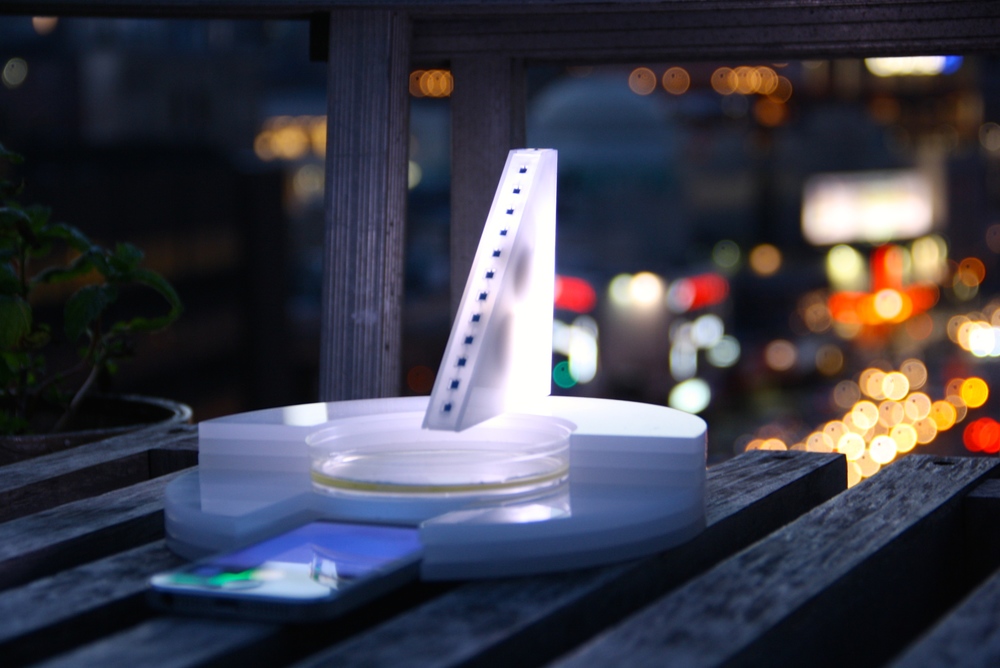
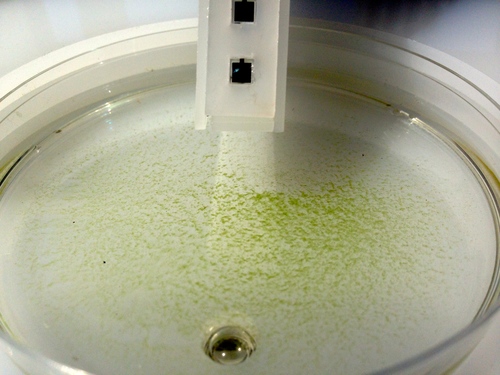
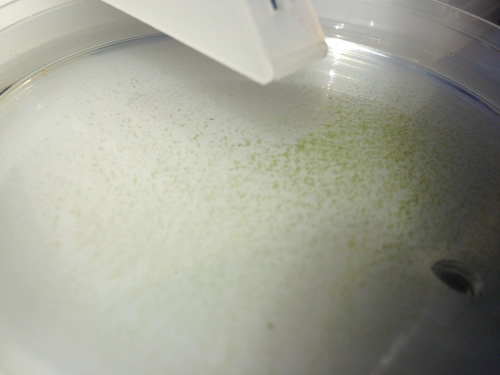
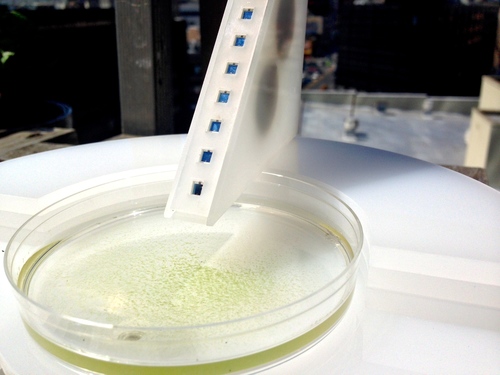
Duration is a pseudo-utilitarian decorative object and living representation of time, inviting the viewer to explore and form closer relationships with living matter as biotechnology slowly enters the mainstream. Duration includes the single cellular organism Euglena, who has the biological ability to follow light. The coupling of the sundial aesthetic and function with the solar energy system create a direct allegory to the biological properties of the Euglena. Hence, the object is self sustainable and functions similarly to living matter. It lives outside or in your window sill during the day, creating shapes and patterns of Euglena conglomerations over time, visible to the naked eye through the green color. The design invites the viewer to observe and share the behavior of the Euglena through the front camera and an embedded microscopic lens. The top of the sundial is designed with miniature solar cells that grab the energy and store it in the object to light up at night, keeping the living organisms in good condition and highlighting notions of technology and nature in semiosis.

Materials
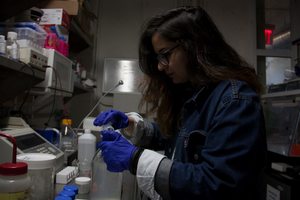
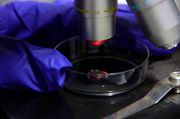
Euglena, acrylic, miniature solar cells, rechargeable litium coin cell batteries, petri dish, microscopic lens, LED's, iPhone. Experiments conducted at Genspace Biolab.

User experience
Explorative, educational, informative, decorative, contemplative, participatory.
Roles
Concept design, bioart, physical computing, product design, UX/UI.
DESIGN PROCESS
1- Identify Areas of Opportunity: Based on given non-harmful unicellular organisms and conceptual challenge.
2- Research: Projects exploring DIY biotechnology and product design, biological properties of photosynthetic organisms.
3- Hypothesize: Create a hypothesis based on the properties of the Euglena in specifically designed environments.
4- Experiment: Several experiments where conducted to test our hypothesis of Euglena’s properties in specified environments.
5- Analyze Data: Gather data and draw conclusions.
6- Envision: Sketch out different scenarios of use and translation.
7- Ideate: Digital sketches and drawings for laser cutting, circuit design.
8- Test: User test evaluating acquisition of desired feelings.
9- Iterate: Amplification, debugging and display.
reflection
The Euglena function as both animals and plants, they eat food and go through photosynthesis depending on the conditions they are in. Much of the Earth’s outer geological formations are due to cyanobacteria such as Euglena, and it is interesting to contemplate the range in which these bacteria have been influential to our existence. We are talking about scale, which is an important factor for designers to get familiar with as we will increasingly deal with organic and living materials. As before the cyanobacteria where responsible for a majority of the Earth’s formation, in modern times humans have taken over that task. This juxtaposition is communicated through the use of the sundial as a representation of the solar system as a chosen time factor, in conjunction with the Euglena escaping this light - rejecting this notion. As the Euglena have their own perception of time which is highlighted by the environment designed for them in the object, we are encouraged to have empathy for a different life form, a different scale.

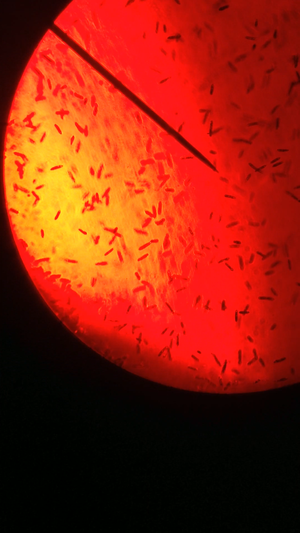
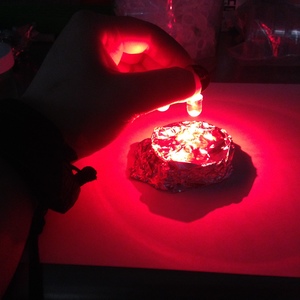
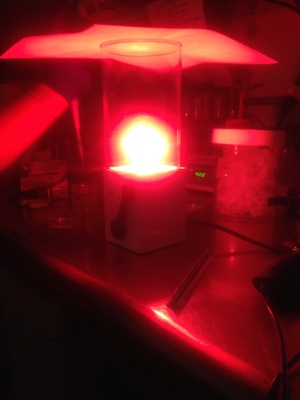
In order to test our hypothesis of the Euglena visually moving in our specific context, we had to conduct a series of lab experiments. It is clear that Euglena follows light, but this varies a lot depending on external conditions. They thrive in temperatures between 18-22 degrees Celsius, and their time cycle varies a lot. They precisely gate gene expression and metabolic activities over a 24-hour period, however their cell cycle ranges vastly from ten hours to ten years depending on the specific species. Following a protocol, we where able to test in which light and under which conditions they would move. Euglena has the ability to travel very fast; relatively they are able to swim as fast as a Boing Jet plane.
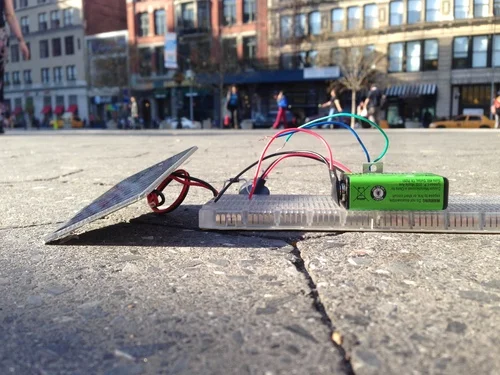
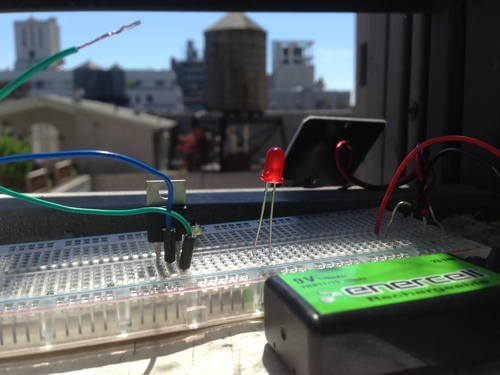
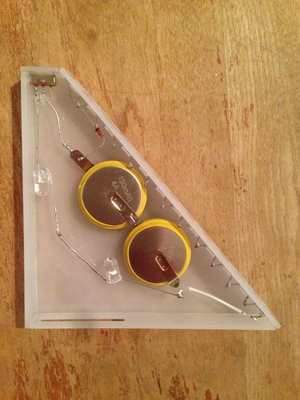
The 12 miniature solar cells grab the energy from the sun and store it into lithium ion rechargeable batteries to use it during nighttime. The circuit enables the powering of the light feature and therefor lights up softly during the night to keep the Euglena happy and well. Nature and technology are in osmosis and live in this spatiotemporal piece, putting forward notions of time-space relativity by creating a self- sustainable timepiece. The technical aspects where designed to be subtle, shining through the translucent Plexiglass they evidently demonstrate their purpose without distraction. The circuits all needed to be as small as possible and neatly arranged as they are part of the aesthetic, communicating the ways in which the Euglena live in symbiosis with technology in this particular piece. Through our experiments, we where able to collect around 0.1 volts/hour of direct sunlight. However, this number would fluctuate quite dramatically depending on the specific conditions. The circuit was prototyped on a breadboard with a bigger solar panel, and then transferred to the miniature solar panels. The decision to put them on the axis of the sundial was both practical as well as aesthetic, accentuating the sun as a source of energy.
